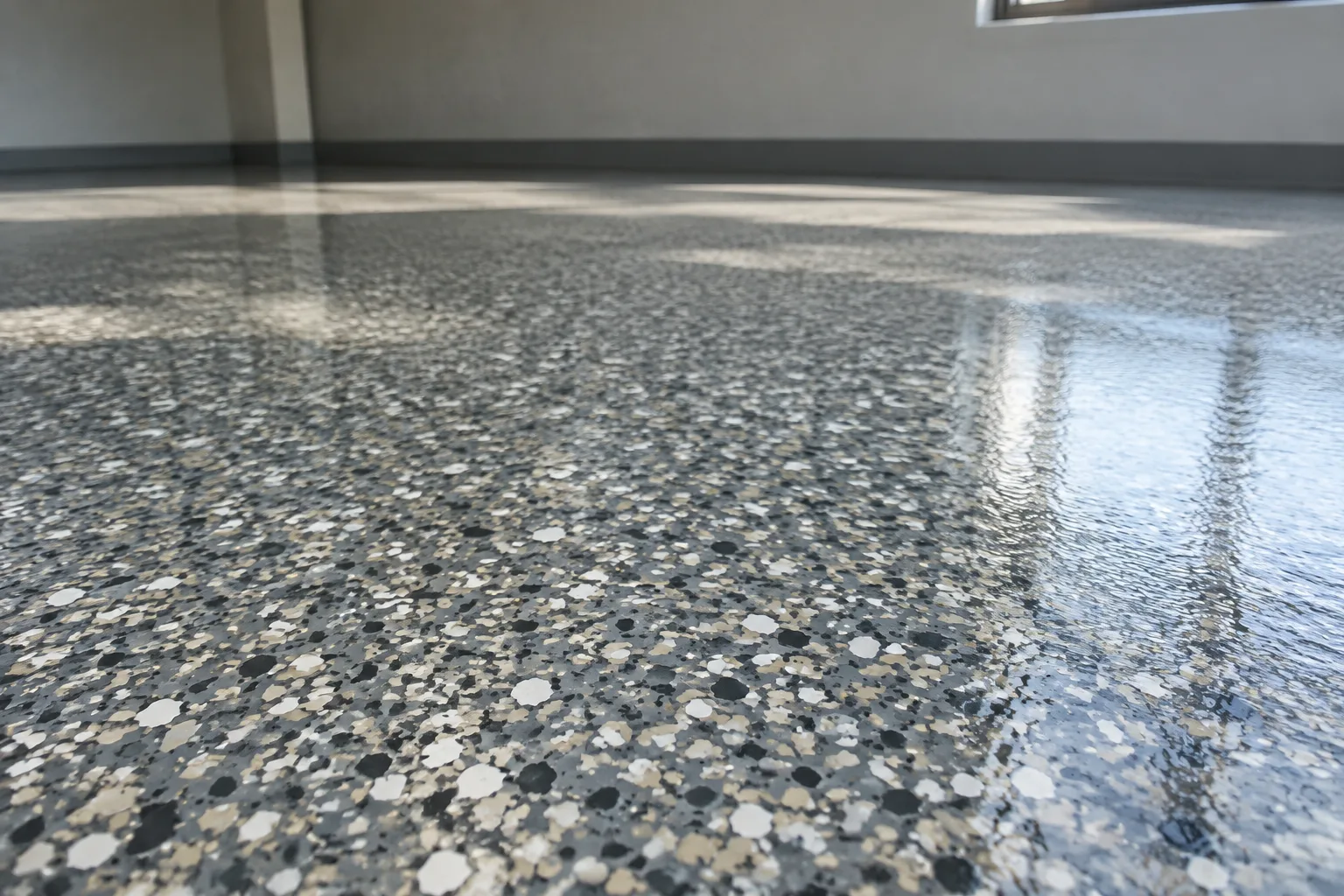
Flake epoxy floors, and an honest word on grip
Coloured vinyl chips scattered into wet epoxy give a speckled floor that forgives dust, paw prints and the odd dropped spanner. It is a favourite for garages and workshops for good reason.
What it does not give you, by itself, is a grippy surface. In a city where floors near the door are often damp from rain or a wet dog, that is worth knowing before you choose.
Get a Free QuoteWhere a standard flake floor sits on the slip scale
Flooring in Europe is often graded on a ramp: a tester in standard test shoes walks an oiled sample while the ramp tilts, and the angle where footing fails sets the class. One well-known full-flake epoxy system sold here publishes an R9 result. That is the bottom band.
| Class | Ramp angle reached | Slip resistance |
|---|---|---|
| R9 | over 6° to 10° | low |
| R10 | over 10° to 19° | normal |
| R11 | over 19° to 27° | raised |
| R12 | over 27° to 35° | high |
| R13 | over 35° | very high |
Classes and angles from the German ramp test as summarised by Baunetz Wissen. The R9 result is from the manufacturer's system data sheet for a decorative full-flake epoxy, September 2026.
Indoors, under a roof
Garages, workshops, laundries, storerooms, gyms and shop floors are where flake makes sense. For the strip inside a garage door, or a laundry where the washing machine sometimes leaks, we blend fine quartz into the last coat. The floor still looks like a flake floor; it just stops feeling like glass under a wet shoe.
Out in the weather
The decorative flake system we used for the figures on this page is rated for interior use only. Sun and driving rain on an open patio need a different product, one its maker rates for outdoor use, finished with a sand texture. Ask us about it for pool surrounds, outdoor showers and braai areas.
From bare slab to sealed chips
After grinding and priming, a coloured epoxy layer is rolled on and flakes are thrown over it by hand until no wet resin shows. Once that has set, the loose chips are swept off for reuse and the whole surface is sanded, because the points of upturned flakes are sharp. A clear seal locks everything in. The published build for one system is 2 to 3 mm with 3 mm chips.
Humidity governs the timing. The system's own limit is 80% relative humidity, and Durban sits at that average from January to March. On a summer job, expect an early start and a pause if the afternoon air turns heavy.
At about 30 °C the same sheet gives roughly 12 hours to foot traffic and 5 days to full cure. At 20 °C, allow 16 hours and about a week.
Where flake fits, and where it does not
The obvious home for it is a garage slab that sees cars, bikes and boxes. Small workshops and storage units in Pinetown and New Germany suit it as well, though heavy forklift aisles are better served by an industrial-grade system. If you are converting a garage into a hobby room in Durban Northor anywhere else, a mid-tone chip blend keeps it from looking like a car park.
Flake usually costs a little more than a single solid colour because of the extra material and the sanding. Our pricing page sets out how the options compare.
Flake floor questions
Choose your chip blend on site
Tell us the room, its size and whether it ever gets wet. Asking for a quote costs nothing.
Get a flake floor quote