Industrial epoxy floors for Durban factories and warehouses
Since March 2025 the General Safety Regulations spell it out: an employer must keep floors, walkways and gangways in good repair, skid-free and clear. A cracked, dusty slab with oil patches in the forklift lanes falls short on all three counts.
We coat production floors, stores, workshops, loading areas and retail back-of-house across the metro, and we pick the system to suit what actually happens on your floor.
Request a site assessment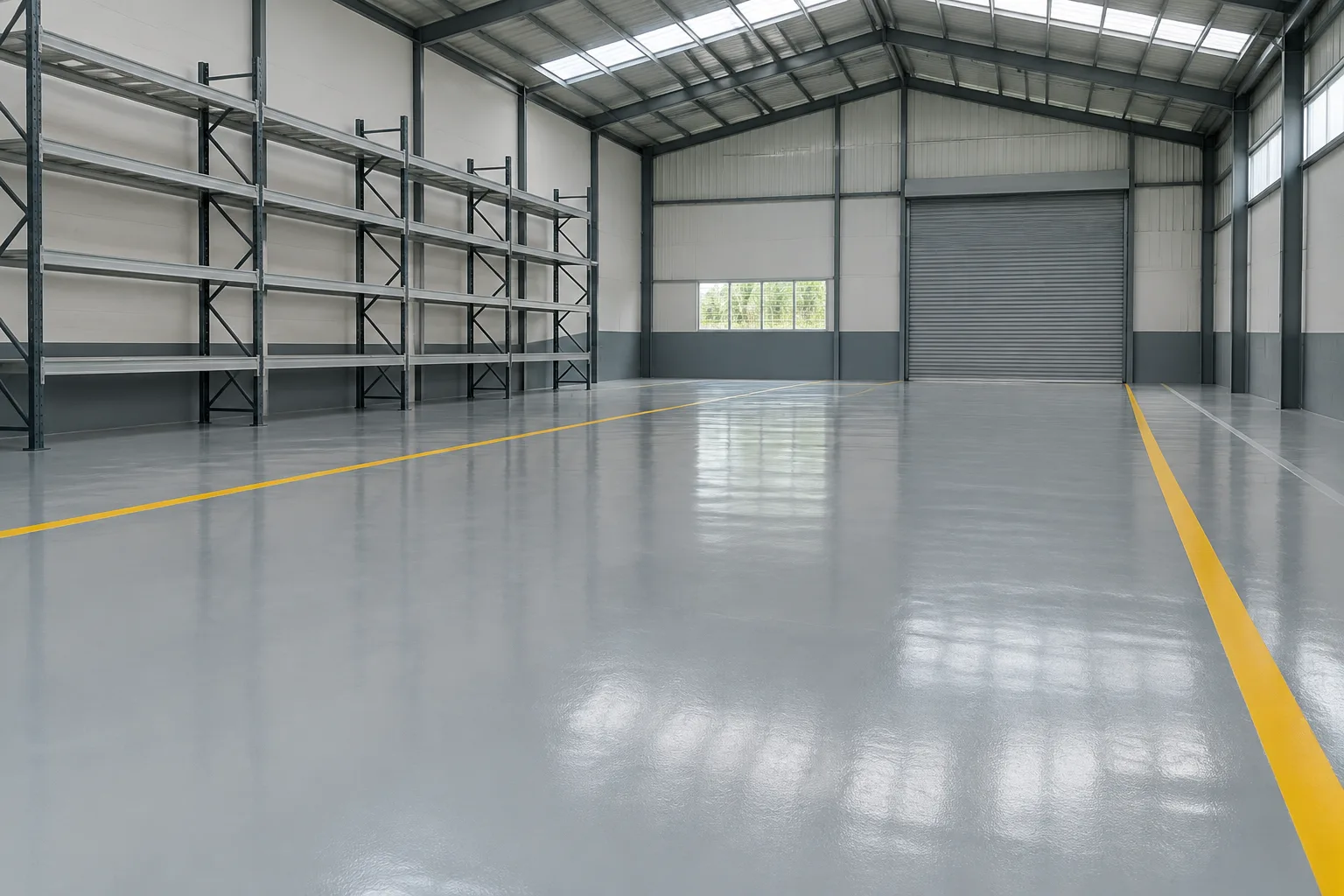
The industrial belts we travel to
Durban's factories cluster in a few well-defined places. Inland, Pinetown is one of the four main industrial hubs of the Durban-Pinetown region, with Westmead, Mahogany Ridge and Alexander Park to the west and New Germany's Falcon, Mountain Ridge and Pineside parks to the north. South of the city, Mobeni and Prospecton sit inside the South Durban Basin, a heavily industrialised stretch south of the city centre.
Commercial floors are a different brief: showrooms, clinics, gyms and office kitchens along the north coast, including newer developments around Umhlanga. Those usually want a cleaner look and less texture, and work after hours.
Four questions that decide the system
Industrial floors fail when the coating is wrong for the conditions. These are the checks behind every recommendation we make.
Can the concrete hold it?
Typical floor epoxies call for concrete rated at 25 N/mm² or more in compression and a surface that stays put when a bonded test dolly is pulled at 1.5 N/mm². We run pull-off tests on old slabs, especially where oil has soaked in.
How wet is the slab, and the air?
Once the concrete reads above about 4% moisture, a standard epoxy needs a cement-based temporary moisture barrier underneath. The air matters too: the same products top out at 80% relative humidity, which is Durban's January to March average. Big roller doors left open on a humid day can stall a job.
Is there heat on the floor?
A common epoxy is rated for 50 °C of dry heat continuously, with occasional steam cleaning up to about 80 °C only in a thicker broadcast build. Ovens, fryers, hot washdown and cold-room doors call for polyurethane cement flooring instead.
What wheels and boots cross it?
Pallet jacks, forklifts and steel-wheeled trolleys are better served by a thicker, sand-filled layer than by a thin roller coat. Wet production areas need quartz broadcast into the surface for grip. Dry packing and storage can take a smoother finish.
Keeping the site running while we work
Large floors are done in sections with taped boundaries, so one bay cures while the next is ground. Grinding is dust-extracted. Once the coating is down, allow roughly a day before people walk on it, four days before light vehicles, and a week before full load and chemical exposure, at around 20 °C.
If a store needs warming on a cold winter night to keep the cure moving, it has to be electric. The manufacturers warn that gas and paraffin heaters pump carbon dioxide and water vapour into the air, and both can spoil a fresh epoxy surface.
Clean manufacturing has its own demands. One widely used floor epoxy carries a particle-emission qualification to ISO 14644-1 class 4 and a GMP class A report, which matters to pharmaceutical, electronics and packaging lines that are audited on dust.
Walkway lines, pedestrian crossings and bay numbers go on after the base system, in contrasting epoxy. Smaller units and workshops sometimes prefer a flake finish that hides wear between cleans.
Industrial work is priced per project after a visit. For a feel of how floor size and system drive the number, look at the pricing overview.
Questions from factory and warehouse managers
Get the floor assessed before you budget
Send the floor area, what runs across it and how long it can be closed. A quote costs you nothing.
Book a site assessment